NBA
NBA PM: Semi-Pro League Recruits Prep Stars


Updated08 Aug 2022
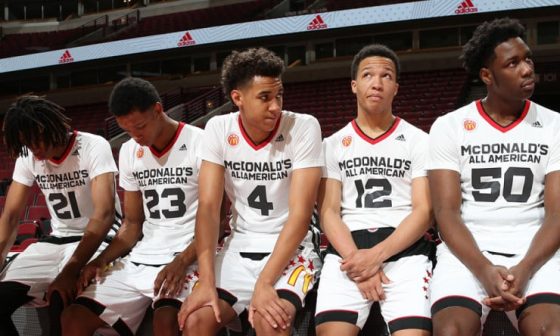
Semi-Pro Team Recruiting High School Stars
Since the NBA’s age limit banned high school players from entering the draft back in 2006, prospects determined to take the prep-to-pro route have had to get creative.
Some players decided to sign a lucrative contract with an overseas team, like Brandon Jennings did in Italy and Emmanuel Mudiay did in China. Others, who didn’t want to leave the country, chose to sign with a D-League team and make less than $20,000, like Latavious Williams did back in 2009.
But what if a third option existed, one that allowed a top high school player to make millions of dollars without having to travel across the globe as a teenager? If a player could sign an enormous contract while remaining in the United States, would that option become popular among high school stars?
Cerruti Brown wants to find out.
Brown is a businessman who is the founder of the six-team, semi-pro AmeriLeague. The league was formed “to create another option for one-and-done high school talent” and, according to Brown, they have already started making large offers to prospective players. One team, named the Dealers, has been making pitches to some high schoolers.
Brown says that the Dealers are offering between $700,000 and $2.5 million for top high school stars, with the figure varying depending on the individual’s skill set and notability.
“To determine the salary, we look at a lot of things,” Brown told Basketball Insiders. “We’ll look at their overall talent. We look to see if the kid is already being projected as a consensus lottery pick on mock drafts. We also look at their marketability – the guys who have the personality to go along with the skill set. We want guys who will be attractive to corporate sponsors as well. We like those kids who have that swagger and ‘it’ factor, the players who are exciting and who kids look up to.
“There have been some reports – some accurate and some inaccurate – about what we’ll spend, but the most that has been put on the table so far is $2.5 million. We haven’t reached an agreement with that player yet, but neither side has ended the talks. But from our standpoint, that’s a huge chunk of change to spend on a player and they would have to be a sure-thing. But yeah, if they’re a projected lottery pick and a McDonald’s All-American and are notable, that number could end up being $2 million to $2.5 million at the end of the day. But, to be clear, it would have to be for the right player.”
If Brown’s idea takes off, this could present the best of both worlds for top high school players since they can earn a huge pay check in their one-and-done year without having to travel abroad. Ted Kapita, a four-star recruit, is the first player who has signed to play in the AmeriLeague.
“This was kind of a no-brainer,” Brown said. “We wanted to think of an option that could be better, as far as the pay, than going overseas or going to the D-League. I’m not going to toot my own horn or anything because I think it’s something that a lot of people have thought of, but just didn’t know how to get it off the ground. A lot of things have to fall into place to get it off the ground, but the idea itself was a no-brainer. This can be the best opportunity for one-and-done players.”
While adding Kapita gives the league some exposure, Brown admits that he’s mainly focused on the 2016 class of players. Because he was able to reach out to those players and their families much earlier in the process, he says a number of top prospects have expressed serious interest. Brown confidently states that his goal is to have multiple McDonald’s All-Americans suiting up for the Dealers next season.
“When we came out with the announcement, we were kind of behind the eight ball on the class of 2015 and I didn’t want to step on a lot of coaches’ toes since a lot of players had already committed and signed letters of intent,” Brown said. “But we were still able to get into the homes and meet with seven of the top 20 players in the class of 2015. Some were serious conversations, some were just meet and greets to feel out the situation and receive more information. Two conversations were very serious and now we’re down to crunch time. And, look, with something like this that is brand new, everyone wants to push the envelope and see if they can get more than the initial negotiated sum of money that was brought to the table. So we’re going to the wire [with the negotiations]. We signed Kapita, he was the first one.
“But with the 2016 class, we’re right in there with Kentucky and Duke and all of the top college programs as far as recruiting. We’ve been targeting that class and have been in constant communication with those prospects. We’ve been in homes and had serious talks. It’s going well so far. Really, [the negotiations] come down to the risks involved for all parties. They’re asking, ‘What if certain things happen, what if it folds?’ But on the flip side, as a businessman, I’m asking, ‘What if you don’t pan out? What if there’s a major injury? Will we lose money on this?’ The talks are going well and I think we can have multiple 2016 recruits next year.”
In addition to top high school players, Brown says the AmeriLeague wants to attract D-League players, overseas players and even fringe NBA players. So far, they have added former NBA players Terrence Williams, Dajuan Wagner, Josh Selby, David Harrison, Antoine Wright, Royce White and Joe Crawford to the league, and more announcements are expected very soon. This would provide quality competition for the high school talent the league attracts, while also growing the AmeriLeague brand. The fact that the AmeriLeague pays more than the D-League has enticed many players.
The salaries for D-League players are tiered, paying $13,000 to tier-one players, $19,000 to tier-two players and $25,500 to tier-three players. Of course, the players make more if they get called up by an NBA team, but there’s no guarantee that will happen. Brown says that the AmeriLeague will have a tiered payment system too – paying $26,000 to tier-one players, $34,000 to tier-two players and $44,000 to tier-three players – so even the lowest-paid AmeriLeague would be making more than the highest-paid D-Leaguer.
D-League salaries will likely be increasing in the near future due to the NBA’s new television rights deal, according to league sources, which could hurt AmeriLeague’s pitch. But it remains to be seen how much the D-League contracts will increase, and AmeriLeague could always respond with a subsequent pay bump of their own.
“When we first came out with this, everyone asked, ‘Well, who are you going to play?’ With the launch of AmeriLeague, we’re going to target D-League players and the overseas guys who want to stay in America,” Brown said. “We want to build a minor league that is on the highest level competition wise and skill-development wise.”
The league is being funded by an investment group that includes wealthy businessmen as well as several current and former NBA players, according to Brown. Also, Brown wanted to stress that the players will be covered by the Provenance Specialty Insurance Agency in the event of injury, removing some of the risk for the prospects.
While the money is certainly tempting, one of the most interesting aspects of this route for high school stars is the mentor program that they are creating. Brown will have former NBA players teach the young prospects about achieving success in the NBA and being professionals. Brown says the program will be led by nine-year NBA veteran Jerome “Junkyard Dog” Williams, who is the Las Vegas Chapter President of the National Basketball Retired Players Association. Other retired players (and some current ones) have committed to be involved as well, according to Brown.
In addition to players, Brown has lined up executives from Fortune 500 companies and financial planners to speak to the players about business, so they can prepare for life after basketball as well. Basically, instead of going to college courses for one year, the players in the AmeriLeague will be attending seminars that are applicable to their basketball career and post-playing opportunities.
“We want to prepare players for every step of their life,” Brown said. “We want them succeeding in the NBA. We want them succeeding after their playing career is over. We want them succeeding in their other endeavors. We want them succeeding as members of their community. The money is great and can definitely help them and their family, but we’re also providing the resources to thrive for the rest of your life. We aren’t making them sit in an Algebra 2 class. The players aren’t caring about that. We’re teaching them to succeed in the NBA, build their brand and manage their money. That’s the biggest thing that I want to get out there: Yes, we’re giving big contracts to young players, but we’re helping them too.”
Also, the AmeriLeague is expecting to hire a number of experienced D-League coaches and former NBA players to coach the six teams, giving the one-and-done players even more guidance from experienced pros. So far, the AmeriLeague has hired former NBA veteran Tree Rollins and former Washington Wizards skills and development coach Joe Connelly III (who is the brother of Denver Nuggets general manager Tim Connelly) as head coaches.
“We’re going to bring in some of the best young, up-and-coming coaches who are looking for their big break, as well as notable former NBA players to coach these six AmeriLeague teams,” Brown said. “We’re going after those kinds of coaches who can garner respect from prospects and really help these players develop.”
Brown has talked to NBA executives about the AmeriLeague’s model and he says they love the idea, particularly since players should be more mature and prepared for the NBA from being mentored by the retired athletes. Another benefit of the one-and-done players suiting up in this semi-pro league is that all of the involved parties won’t have to follow the strict NCAA rules. Players’ on-court time won’t be limited, they can focus all of their time on basketball and executives can scout them as much as they want. Of course, NBA officials would still have to limit their contact to some extent due to NBA rules, but the NCAA rules wouldn’t apply to the AmeriLeague teams. Also, Brown is planning for all six AmeriLeague teams to be based in Las Vegas, making it easy for scouts and executives to see all of the notable players in one trip.
“To be honest, the NBA executives and coaches and agents I’ve talked to love the concept because they feel this is needed,” Brown said. “As long as this is run right, the NBA is going to benefit because we’re going to prepare the kids and make sure they’re mature enough to succeed in the NBA.”
This season, the AmeriLeague season will tip off on November 9. Starting in 2016, the league planning to start their season sooner (likely on August 1) since that’s when there’s not much basketball content available and passionate fans are craving a hoops fix. Brown says that the 2016 season would run from August through December.
In addition to filling a void in the basketball schedule, this would also give players a chance to sign a second contract and make more money once the AmeriLeague season concludes. The one-and-done players could join an overseas team if they choose, while the veteran players could potentially join an NBA or D-League roster.
“The things we have going for us is the mentor program, the increased salaries, the tiered payment system and our league will last just a few months so players can go sign elsewhere and make even more money after playing with us,” Brown said. “We aren’t holding anyone hostage; we want them to maximize their earnings.”
As Brown has tried to launch this idea, he has gotten some push-back from people who are benefiting from the current one-and-done model. He knows those people will try to stop the AmeriLeague from launching and succeeding, but he’s not giving up.
“The majority of people who don’t want this to happen are the people who have their hands in the cookie jar making money off the high school players and the [current model],” Brown said. “They don’t want the top prospects joining us, and I understand that. Those people will be the first in line doubting us and saying it’s never going to happen, but I know that we can do this. When you’re talking about the money that we have to offer, anyone with common sense is going to hear this pitch. We know it’s not for everybody, but we believe we can find some players and families who believes this makes a lot of sense and they’ll act on it.
“Also, I know people don’t like change, but everyone complains about the shadiness of recruiting and the money changing hands under the table. Well, we’ve got nothing to hide! We’re putting the money on top of the table and saying, ‘Take it or leave it.’”
In terms of exposure for the players, Brown has reached a deal with Mandalay Sports Media to create a film about the Dealers’ journey, which will be aired on VICE Sports. Also, Brown says that he has also been in talks with VICE Sports about potentially broadcasting AmeriLeague games, so fans could watch these top prospects in action. The goal eventually is to have these games nationally televised on a station like ESPN or Fox Sports, much like “The Basketball Tournament” just did with their unique idea.
After talking to Brown and hearing all of the details of the AmeriLeague, I reached out to several former high school stars who went on to play professional basketball to ask: Would you have taken $1 million to play for a semi-pro team straight out of high school had this option been available to you?
Five players said yes, three players said no and one said maybe. Below are some of the responses from players, who spoke under the condition of anonymity.
“Hell yes, I would’ve taken that!” said a five-star recruit who was one of the most highly coveted recruits in his class. “Hell yeah! No question.”
“I wouldn’t have taken it,” added a former McDonald’s All-American. “I wanted to experience college. One million dollars is nothing when you have guys like Draymond Green getting $80 million or more after going to school for four years. The risk is not worth the reward. Also, when you skip school like that, for some reason those guys get a negative reputation; for example, Brandon Jennings, Jeremy Tyler and Emmanuel Mudiay. I wouldn’t have taken it.”
“I would have accepted the deal,” added another former McDonald’s All-American. “I would’ve wanted to talk to my family and advisers and see what they thought. But if they agreed, I would’ve done it. It would be really hard not to take it.”
“Wow. I mean, I think I would have taken it, to be honest,” added another former McDonald’s All-American. “I’m sure a lot of guys will take that offer.”
“Nah, I wouldn’t have taken it because I grew up dreaming of playing college ball,” said another former McDonald’s All-American. “That’s the only reason why I wouldn’t do it. It’s a good idea though.”
With the significantly larger salaries, a mentor program designed to prepare players for the NBA and the ability to attract and showcase some of the game’s top young players, Brown’s AmeriLeague could be a game-changer in the basketball world.
“I believe this can be the top minor league for basketball,” Brown said. “This could be big.”